Local Guide
Garage Floor Coating in Metro Detroit: What Local Homeowners Need to Know
Metro Detroit garages face challenges most national coating companies don't account for — freeze-thaw cycles, road salt, MVT from older slabs. Here's what to look for in a local installer and what your slab actually needs.
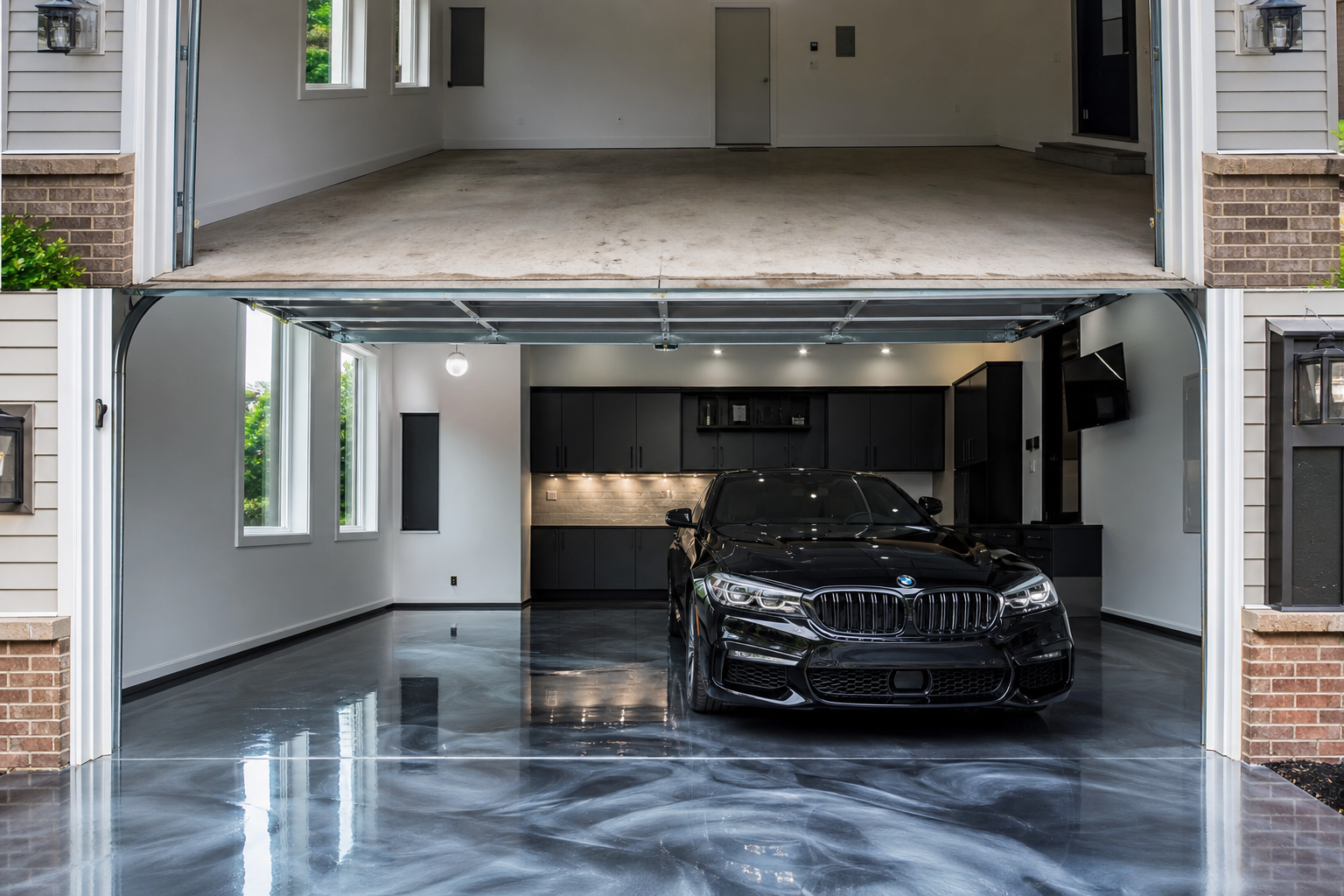
If you've started shopping garage floor coatings in Metro Detroit, you've probably noticed two things. First, there are a lot of companies — national franchises, local installers, hardware-store kits, mobile pop-up crews. Second, most of them describe their product in identical terms. "Lifetime warranty." "One-day install." "Stronger than epoxy." It's hard to tell what's actually different.
Here's the part most of those companies don't lead with: Metro Detroit garages are not the same install job as garages in Arizona or Florida. The climate, the slab age, and the way road salt gets tracked into the garage every winter create specific failure modes that a generic national-brand install will run into eventually. If you understand what those local factors are, you can ask the right questions and end up with a floor that actually lasts.
This post is a homeowner's guide to what's different about coating a garage floor in Southeast Michigan, what to look for in a local installer, and which questions separate the companies who know the territory from the ones reading from a script.
Three things Metro Detroit does to your garage floor
1. Freeze-thaw cycles are brutal on coatings
Detroit sees temperature swings that few coating chemistries are designed for. A slab that's 20°F overnight and 45°F by afternoon — common in February and March — is constantly contracting and expanding. The coating has to move with it or crack.
This is why rigid coatings like budget epoxy fail faster here than they do in milder climates. Epoxy is a thermoset; it cures into a hard, glassy film that doesn't flex. When the slab beneath it moves a few thousandths of an inch with the temperature, the coating either cracks or delaminates.
Polyaspartic and polyurea-based systems handle this better because they cure into a slightly flexible film. They expand and contract with the concrete instead of fighting it. For a Metro Detroit garage, that flexibility is the single most important coating property after slab prep — and it's not something most companies talk about.
2. Road salt is a chemical attack, not just a stain
Salt that gets tracked in from snowy streets isn't just unsightly. It's actively corrosive. Sodium chloride combined with the moisture in melting snow creates a low-grade chemical environment that attacks both the coating and the concrete underneath. Over years, salt-laden meltwater can soak into uncoated concrete and accelerate spalling — that flaking, pitted surface you see on older driveways.
A proper garage floor coating creates a chemical barrier between the salt and the slab. But the coating itself has to be salt-resistant, which not all of them are. Polyaspartic and polyurea systems hold up well. Older epoxy formulations, especially the budget DIY kits, can chalk or soften with repeated salt exposure.
The other thing this means: if your garage floor is already pitted or spalling from years of salt exposure, the prep work before coating is more involved. Loose concrete has to be ground out, low spots have to be filled with a polymer-modified patch, and any active deterioration has to be stopped before the coating goes down. Skipping this prep is how you end up with a coating that lifts in three years.
3. Older slabs were poured without vapor barriers
A lot of Metro Detroit housing stock was built between 1940 and 1980, and a meaningful percentage of those garage slabs were poured directly on dirt with no plastic vapor barrier underneath. Code in most municipalities now requires a barrier under any new slab, but older garages don't have one.
Without a vapor barrier, groundwater under the slab evaporates upward through the concrete pores. This is called Moisture Vapor Transmission (MVT), and it's the silent killer of garage floor coatings on older homes. The vapor pressure literally pushes the coating off the slab from underneath. You'll see blisters, bubbles, or peeling concentrated in one area — usually whichever part of the garage sits over the wettest soil.
This is why any reputable installer working on a Metro Detroit garage built before 1990 should be doing a moisture test before they quote you a coating. Not after the install. Not "we'll figure it out when we get there." Before.
The standard test is ASTM F1869, a calcium chloride dome that measures moisture emission over 24 hours. If the result is above 4 lbs per 1,000 sq ft per 24 hours, a standard coating will fail. The slab needs a moisture-mitigating primer or a full vapor barrier system underneath the coating. Companies that don't test for this — and there are many — will install a coating that lifts within a year or two, then tell you it's not covered under warranty because of "site conditions."
What to look for in a Metro Detroit installer
A few questions separate companies who know the local territory from the ones who don't:
Do you moisture-test older slabs before quoting? The right answer is yes, with a calcium chloride or Tramex meter test on any pre-1990 home. The wrong answer is "we don't usually need to" or "we'll just use a thicker primer."
What's your prep process for a pitted or salt-damaged slab? The right answer involves diamond grinding to expose sound concrete, polymer-modified patching for the worst spots, and crack repair before any coating goes down. The wrong answer is "we'll roll a primer over it."
Can you install in cold weather? Metro Detroit's coating season runs longer than most homeowners think if your installer is using polyaspartic or polyurea systems, which cure down to 0°F. If a company tells you they can only install May through September, they're using older epoxy chemistry and you're getting a more limited product.
What's the workmanship warranty, and what voids it? Read the fine print. "Lifetime warranty" usually covers product defects only. A 10-15 year transferable workmanship warranty from a local company you can actually reach is more valuable than a "lifetime" warranty from a national franchise with high turnover.
Are you licensed and insured for work in Michigan? Michigan requires contractors performing work over $600 to be licensed. Insurance should include liability and workers' comp. Ask for proof — reputable companies share it without hesitation.
What a proper Metro Detroit install actually looks like
Here's the install sequence for a properly executed garage floor coating in Southeast Michigan, especially on an older slab:
- Site assessment. Measure the slab, check for cracks, assess existing damage, identify the slab's likely age, and ask about water issues (sump pump, gutters, basement moisture).
- Moisture testing if the slab is pre-1990 or shows any sign of MVT — efflorescence, prior coating failure, dampness.
- Oil contamination assessment in zones where vehicles have been parked. Petroleum drawing protocols if needed.
- Diamond grinding of the entire slab to expose aggregate and create the surface profile coatings need to bond. Most reputable shops grind to a CSP-2 or CSP-3 profile.
- Crack and joint repair using polymer-modified or polyurea-based repair products. Cracks get routed and filled, control joints get treated according to the coating system spec.
- Patch and level any spalled or low areas.
- Primer or moisture-mitigating base coat based on what the moisture test showed.
- Base coat application — typically a polyurea base for residential systems.
- Flake broadcast — colored vinyl chips broadcast into the wet base coat for color, texture, and slip resistance.
- Scrape and vacuum excess flake the next day.
- Top coat — polyaspartic for residential systems. UV-stable, chemical-resistant, fast-curing.
- Walk-on the same day, drive-on within 24 hours.
That's a one-day install for the coating portion, plus prep time the day before for grinding and patching. Companies advertising "one-day install" on a slab that needs serious prep are skipping steps — usually the moisture test, the grinding, or the crack repair. Those skipped steps are why some installs lift within two years.
The cost question
Metro Detroit residential garage floor coatings typically run:
- Budget DIY epoxy kit (self-installed): $300–$800 materials, 3–5 year lifespan
- Mid-tier professional epoxy: $2,500–$4,500 installed, 5–8 year lifespan
- Professional polyaspartic system on a sound slab: $4,500–$7,500 installed, 15–20 year lifespan
- Polyaspartic system requiring moisture mitigation or significant slab repair: $6,500–$10,000+ installed, 15–20 year lifespan
The price spread feels wide because it is. The cheapest option works out to roughly $1.50–$2.00 per square foot, the most expensive can be $8–$10 per square foot. On a per-year-of-service basis, polyaspartic on a properly prepped slab is actually the lowest cost — you do it once and it outlasts two or three epoxy re-installs.
The decision usually comes down to how long you plan to be in the house. Selling in a year or two: a cosmetic epoxy refresh might make sense. Staying for the long haul: spend the money on doing it right once.
A note on national franchises vs local companies
Both can do good work. The questions to ask are the same regardless. But there are tradeoffs:
National franchises have brand recognition, financing programs, and standardized warranties. The downside is that the install crew is often a local subcontractor whose quality varies, and warranty claims can be slow because they route through corporate.
Local companies are easier to reach, generally more flexible on scheduling, and the owner usually has a direct stake in your install going well. The downside is that smaller companies can be harder to vet — fewer online reviews, sometimes less formal warranty paperwork.
For Metro Detroit specifically, look for a company that's been in business at least 5 years (so you know they'll be around to honor the warranty), has Better Business Bureau accreditation, and can show you photos of actual local installs — ideally on homes similar in age to yours.
If you want the deeper technical breakdown of what proper installation looks like — the moisture testing protocols, the grinding profiles, the coating chemistry — our Garage Floor Installation Guide walks through the full spec we follow on every job in Metro Detroit.
The right coating, installed right on a properly prepped slab, will outlast almost everything else in your garage. The wrong one — or the right one installed wrong — will be peeling before your next set of winter tires goes on. Knowing the difference comes down to asking the right questions before anyone shows up with a grinder.
Sources & further reading
- ASTM F1869 — Standard Test Method for Measuring Moisture Vapor Emission Rate of Concrete Subfloor Using Anhydrous Calcium Chloride
- ICRI Technical Guideline 310.2R — Selecting and Specifying Concrete Surface Preparation
- ACI 302.2R — Guide for Concrete Slabs that Receive Moisture-Sensitive Flooring Materials
- Michigan Department of Licensing and Regulatory Affairs — Residential Builder Licensing