Comparison Guide
Polyaspartic vs Epoxy vs Polyurea: Which Garage Floor Coating Actually Lasts?
Three coating chemistries dominate the garage floor market. Here's how polyaspartic, epoxy, and polyurea actually compare on durability, install time, cost, and lifespan — and how to know which one belongs on your slab.
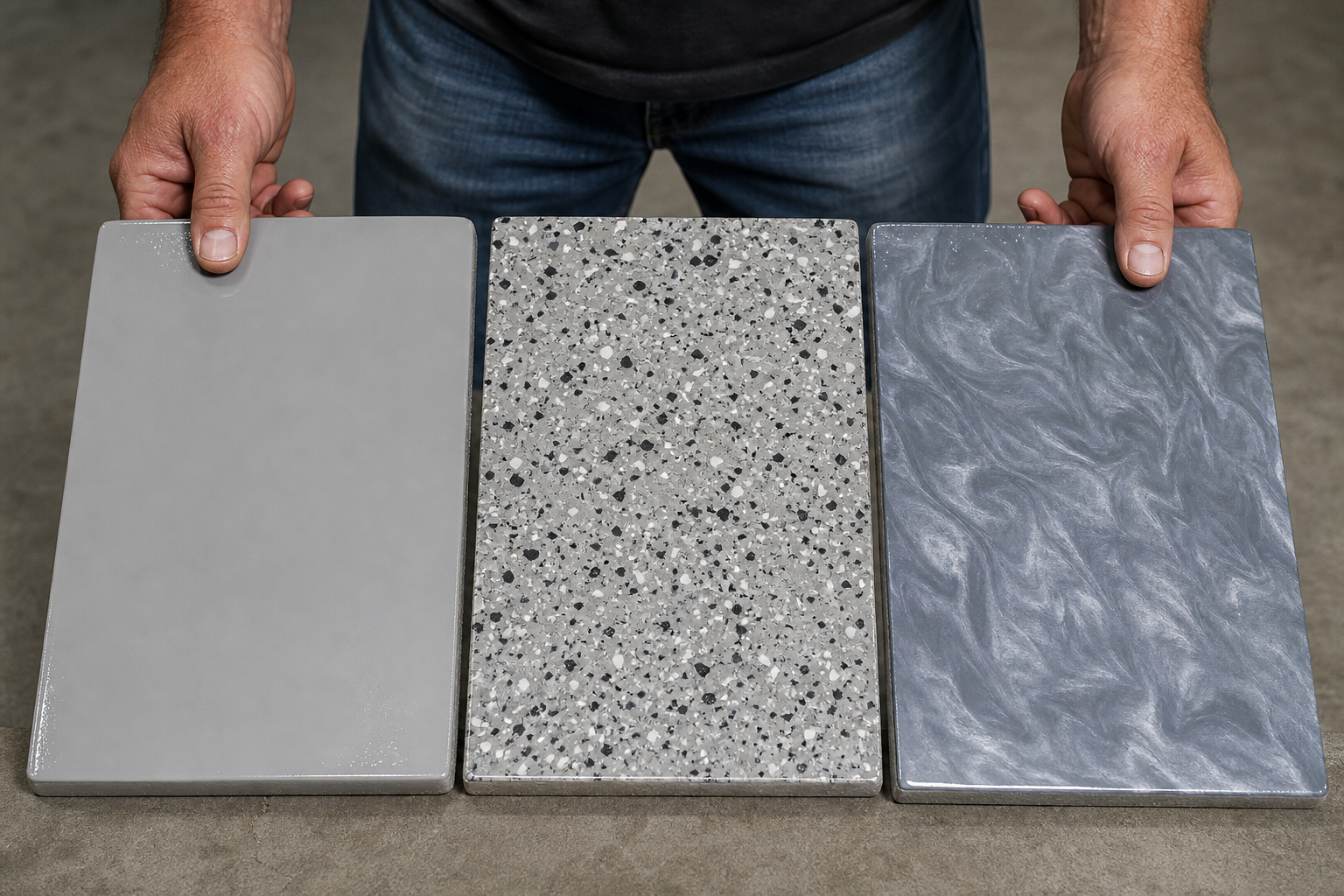
Walk into any garage floor showroom or scroll any coating company's website and you'll see three chemistries that dominate the conversation: epoxy, polyurea, and polyaspartic. The marketing makes them sound nearly identical — "industrial-strength," "lifetime warranty," "scratch-proof." They are not identical. They behave differently on your slab, install differently, last different amounts of time, and cost different amounts of money.
This post breaks down what's actually different, when each one is the right call, and where the marketing crosses into nonsense.
The 30-second answer
If you want the quick version before the detail:
| Epoxy | Polyurea | Polyaspartic | |
|---|---|---|---|
| Chemistry family | Two-part thermoset | Two-part elastomer | Polyurea variant |
| Typical lifespan (residential) | 3–7 years | 10–15 years | 15–20 years |
| Cure time to drive on | 3–7 days | 24 hours | 24 hours |
| Install window per coat | 30–45 minutes | 5–15 minutes | 15–30 minutes |
| UV stability | Poor (yellows) | Moderate | Excellent |
| Temperature range for install | 55°F–85°F | 0°F–140°F | 0°F–140°F |
| Cost (residential 2-car) | $1,500–$3,500 | $3,500–$6,000 | $5,000–$8,500 |
| Best use case | Budget DIY, climate-controlled spaces | Industrial, base coat layer | Premium residential, commercial |
Three real differences drive everything else: how long they last, how fast they cure, and how they hold up to UV. Walk through each chemistry on those three axes and the right pick becomes obvious.
Epoxy: the original, and increasingly the wrong tool
Epoxy is the coating most people picture when they hear "garage floor coating." It's been the dominant product for decades, it's what the big-box DIY kits use, and it's still the cheapest option per square foot.
It's a two-part thermoset: you mix a resin with a hardener, and a chemical reaction over 24–72 hours produces a hard, glossy film. The chemistry is reliable, the product is everywhere, and a properly installed epoxy floor genuinely looks great on day one.
Where epoxy wins: Cost. A self-installed kit can cover a two-car garage for under $400 in materials. For a basement, workshop, or any space that doesn't get UV exposure or extreme temperature swings, a well-prepped epoxy floor is fine.
Where epoxy loses:
- UV exposure yellows it. Sunlight through a garage door window, and the coating ambers within a year or two. By year five it can look like dingy beer.
- It's brittle. Epoxy is hard, but hard means it cracks under impact rather than flexing with the slab. Drop a wrench corner-first and you can chip through the coating.
- The install window is wide. Most people read this as a positive — more working time. It actually means longer cure times. You're out of your garage for 3–7 days while the chemistry finishes, and full chemical resistance can take 30 days.
- Lifespan is the shortest of the three. A DIY epoxy kit installed correctly is realistically 3–5 years in a daily-use garage. Professional-grade epoxy gets you 5–7. After that, you're looking at re-coat or removal.
Bottom line on epoxy: It's a budget product. If the price difference matters more than the lifespan difference, it's a valid choice. If you're going to be in the house for 10+ years and you do the math on having to redo it twice in that window, the math stops working.
Polyurea: the industrial workhorse
Polyurea is an elastomer — meaning it cures into a slightly flexible film rather than a rigid one. It's the same chemistry family that makes truck bed liners (Line-X, Rhino) so durable. In the coating world, it's often used as the base coat in a multi-layer system rather than as a standalone finish.
The cure is fast — gel times can be measured in seconds for pure polyurea, which is why it's almost always sprayed by professionals with specialized equipment. For garage floors, slower-formulated polyureas give you a 5–15 minute working window per batch.
Where polyurea wins:
- Flexibility. Because it's an elastomer, polyurea moves with the slab as the concrete expands and contracts. This means fewer stress cracks at control joints and less chipping from impact.
- Speed. A polyurea base goes down, you broadcast flake into it, and you're top-coating in hours, not days.
- Cold-weather tolerance. Polyurea cures down to 0°F. That's why industrial facilities can do winter installations without heating the entire slab.
- Chemical resistance. Stronger than most epoxies against oils, fuels, road salts.
Where polyurea loses:
- UV stability is only moderate. Pure polyurea will fade or chalk under direct UV. This is why it's almost always paired with a polyaspartic top coat in residential systems rather than left exposed.
- Spray equipment is expensive. This isn't a DIY product. You're hiring a professional with the right rig or you're not getting polyurea.
- Aesthetic options are limited as a standalone. It's typically used as the structural layer underneath, not the visible finish.
Bottom line on polyurea: Almost no one installs pure polyurea as a finished residential floor. It's the foundation in a layered system. When you see a coating company advertise "polyurea floor coating," they usually mean a polyurea base with a polyaspartic top coat. Which brings us to the third option.
Polyaspartic: the premium pick
Polyaspartic is technically a subclass of polyurea — it's a polyurea formulated to cure slower (giving installers a workable window) and to be UV-stable. It was originally developed in the 1990s for bridge coatings, where the combination of fast cure, weather resistance, and UV stability solved problems no other product could handle.
That bridge-coating DNA is why polyaspartic dominates the high-end garage floor market. Everything that makes it good on a bridge — UV stability, flexibility, fast cure, chemical resistance — is exactly what a garage floor needs.
Where polyaspartic wins:
- UV stability is excellent. Won't yellow, won't chalk, won't fade. This matters more than most homeowners realize — garage doors open, sunlight hits the floor, and after a few years the difference between "still looks new" and "looks tired" is almost entirely UV degradation.
- Cure is fast. Most polyaspartic systems are walk-on in 4–6 hours and drive-on in 24. A pro crew can do a one-day install where you park your car in the garage the next evening.
- Flexibility plus hardness. Polyaspartic gets the elastomer benefit from its polyurea base chemistry but cures harder than pure polyurea, giving you better scratch resistance.
- Temperature tolerance. Like polyurea, you can install in cold weather without heating the slab.
- Lifespan is the longest. A properly installed polyaspartic system on a properly prepped slab realistically lasts 15–20 years.
Where polyaspartic loses:
- Cost. It's the most expensive of the three. A professional polyaspartic install on a two-car garage typically runs $5,000–$8,500 depending on prep complexity and flake design.
- Working window is tight. 15–30 minutes per batch means installers can't take coffee breaks. A botched mix or a slow crew can leave lap marks.
- DIY is not realistic. The fast cure and tight working window mean almost no homeowner can install polyaspartic well. It's a pro product.
Bottom line on polyaspartic: If you want the floor to outlast your time in the house and you can afford to do it once instead of three times, this is the answer. The cost-per-year math is actually better than budget epoxy when you account for re-installs.
Which one belongs on your slab? A decision tree
The right coating depends on three questions:
1. How long do you want it to last?
- Under 5 years (e.g., flipping the house): Epoxy
- 10+ years: Polyaspartic or polyurea/polyaspartic system
- Industrial use case: Polyurea base with polyaspartic top, or urethane cement for chemical exposure
2. What's the environment?
- Climate-controlled, no UV, no extreme temps: Any of the three works
- Cold weather installation required: Polyurea or polyaspartic
- Direct UV exposure through windows: Polyaspartic, full stop
- Heavy chemical/fuel exposure: Polyurea base with appropriate top coat
3. What's the slab condition?
- Newer, dry, structurally sound: Any of the three
- Older slab with cracks or MVT issues: Skip epoxy. Polyaspartic over a moisture-mitigating primer is the only system that handles this reliably
- Active oil contamination: Petroleum drawing protocols first, then polyaspartic system
What the marketing doesn't tell you
A few things to watch for when comparing quotes:
- "100% solids" doesn't mean better. It means the product is all coating material with no solvents. It's a sign of a quality product but not a differentiator between chemistries — all three are available as 100% solids formulations.
- "Lifetime warranty" is mostly meaningless. Read the fine print. Most "lifetime" warranties cover product defects, not installation failures, and require the original installer to still be in business. A 15-year transferable workmanship warranty from a local company you can call is worth more than a "lifetime" warranty from a national brand that doesn't return phone calls.
- Coating thickness is measured in mils (thousandths of an inch). A quality residential system runs 20–40 mils total. Anything under 15 mils is a thin paint-style coating regardless of what chemistry it uses.
- The slab prep matters more than the chemistry. A poorly-prepped polyaspartic floor will fail before a well-prepped epoxy floor. If a contractor doesn't talk about grinding, moisture testing, and crack repair before they talk about coating selection, that's the warning sign.
If you want to go deeper on what proper slab prep and installation actually looks like — the diamond grinding profiles, the moisture thresholds, the crack repair sequence — our Garage Floor Installation Guide walks through the full spec we follow on every install.
The short version: the right coating is the one that matches your slab, your climate, and your timeline. None of the three is universally better. But for a typical residential garage where you want the floor to last and look good doing it, polyaspartic over polyurea is the system that earns its price.
Sources & further reading
- ASTM D7234 — Standard Test Method for Pull-Off Adhesion Strength of Coatings on Concrete
- SSPC Coating Application Specifications for industrial coatings
- ACI 302.2R — Guide for Concrete Slabs that Receive Moisture-Sensitive Flooring Materials
- Polymer chemistry literature on polyaspartic ester reaction kinetics